The Higgs field, a fundamental concept in particle physics, has revolutionized our understanding of the universe. Proposed in the 1960s by physicists Peter Higgs and others, this field explains how particles acquire mass, a property that has fascinated humans for centuries. The discovery of the Higgs boson in 2012, a particle associated with the Higgs field, marked a major milestone in the history of physics, confirming the existence of this elusive entity.
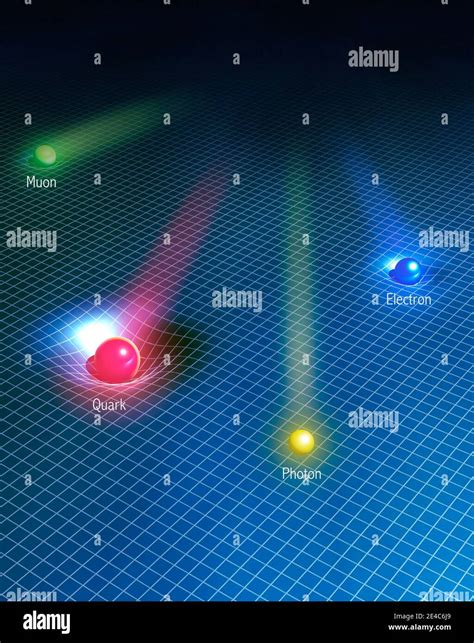
At its core, the Higgs field is a theoretical construct that permeates all of space, endowing particles with mass as they interact with it. Imagine a cosmic molasses that slows down particles as they move through it, with more massive particles being more significantly impeded. This field is responsible for the diversity of masses we observe in the universe, from the lightest neutrinos to the heaviest top quarks. The Higgs mechanism, as it’s known, is an indispensable component of the Standard Model of particle physics, our current understanding of the behavior of subatomic particles.
One of the key features of the Higgs field is its ability to explain the phenomenon of symmetry breaking. In the early universe, when temperatures were extremely high, particles were massless and interacted with each other symmetrically. As the universe cooled, the Higgs field appeared, introducing an asymmetry that gave rise to the diverse range of masses we see today. This concept has far-reaching implications, as it provides a framework for understanding the evolution of the universe and the formation of structure within it.
To grasp the intricacies of the Higgs field, it’s essential to delve into the realm of quantum field theory. This theoretical framework describes the behavior of particles in terms of fields that permeate space and time. The Higgs field is a scalar field, meaning it has a magnitude but no direction, and its interactions with other particles are mediated by the Higgs boson. The discovery of this boson at the Large Hadron Collider (LHC) in 2012 was a groundbreaking moment, as it provided conclusive evidence for the existence of the Higgs field.
The implications of the Higgs field are profound, with far-reaching consequences for our understanding of the universe. For instance, the Higgs mechanism helps explain why the weak nuclear force, one of the fundamental forces of nature, has a limited range. It also provides a framework for understanding the origins of mass, a property that has puzzled scientists and philosophers for centuries. Furthermore, the Higgs field has inspired new areas of research, such as the study of scalar fields and their potential role in the early universe.
The Higgs field is a paradigmatic example of how theoretical physics can lead to groundbreaking discoveries. The concept of a field that permeates all of space, endowing particles with mass, was once considered speculative, but it has now been experimentally confirmed. This demonstrates the power of human ingenuity and the importance of fundamental research in advancing our understanding of the universe.
As we continue to explore the mysteries of the universe, the Higgs field remains a fertile ground for research and discovery. Ongoing experiments at the LHC and future colliders will help refine our understanding of the Higgs boson and its interactions, potentially revealing new insights into the nature of mass and the universe. Theoretical physicists are also exploring alternative models, such as supersymmetry and extra dimensions, which could provide a more complete understanding of the Higgs mechanism and its role in the universe.
In conclusion, the Higgs field is a fundamental concept in particle physics that has revolutionized our understanding of the universe. Its discovery has confirmed our understanding of the origins of mass and has inspired new areas of research. As we continue to explore the mysteries of the universe, the Higgs field will remain a central theme, guiding our quest for knowledge and understanding.
What is the Higgs field, and how does it give particles mass?
+The Higgs field is a theoretical construct that permeates all of space, endowing particles with mass as they interact with it. It’s like a cosmic molasses that slows down particles as they move through it, with more massive particles being more significantly impeded.
What is the significance of the Higgs boson discovery?
+The discovery of the Higgs boson confirmed the existence of the Higgs field, a fundamental concept in particle physics. It marked a major milestone in the history of physics, providing conclusive evidence for the mechanism that gives particles mass.
How does the Higgs field relate to the origins of the universe?
+The Higgs field is thought to have played a crucial role in the early universe, introducing an asymmetry that gave rise to the diverse range of masses we see today. This concept provides a framework for understanding the evolution of the universe and the formation of structure within it.