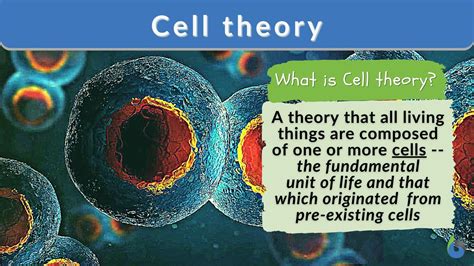
Cell theory, a fundamental concept in biology, revolves around the idea that cells are the basic units of life and that all living organisms are composed of one or more cells. This theory, which has been refined over the centuries, provides a framework for understanding the structure, function, and behavior of cells. At its core, cell theory rests on three primary principles: all organisms are composed of one or more cells, cells are the basic units of life, and all cells arise from pre-existing cells.
The journey to formulating cell theory began with the invention of the microscope, which allowed scientists to observe cells for the first time. Antonie van Leeuwenhoek, often referred to as the “Father of Microbiology,” was among the first to observe and describe microorganisms using his handcrafted microscopes in the 17th century. However, it was not until the 19th century that the cell theory began to take shape through the contributions of Matthias Jakob Schleiden and Theodor Schwann. They observed that plants and animals were made up of cells and proposed that cells were the fundamental units of life.
Historical Evolution of Cell Theory
The historical evolution of cell theory is a testament to the progressive nature of scientific inquiry. Initially, the belief was that living organisms could arise from non-living matter, a concept known as spontaneous generation. However, with the work of Louis Pasteur and others, this idea was disproven, paving the way for the acceptance of biogenesis—the principle that living organisms can only arise from other living organisms.
The cell theory evolved further with the discovery of the cell membrane by Overton and Gorter, which highlighted the importance of the cell’s structure in its function. The discovery of the nucleus by Robert Brown marked another significant milestone, as it identified the site of genetic material within the cell. The development of the microscope and staining techniques allowed for a deeper understanding of cellular structures and their functions.
Essential Concepts of Cell Theory
Understanding cell theory requires grasping several essential concepts:
All Organisms are Composed of One or More Cells: This principle asserts that cells are the basic building blocks of life. Whether an organism is as simple as a bacterium or as complex as a human, it is composed of cells.
Cells are the Basic Units of Life: This concept emphasizes that cells are not only the structural units of living organisms but also the functional and biological units. All the functions necessary for life are carried out within cells.
All Cells Arise from Pre-existing Cells: This principle, known as biogenesis, was a significant departure from the earlier belief in spontaneous generation. It states that new cells can only arise from the division of existing cells, underscoring the continuity of life.
Cell Structure and Function
Cells, whether prokaryotic (lacking a nucleus) or eukaryotic (possessing a nucleus), have structures that are designed for specific functions. The cell membrane, or plasma membrane, is a thin layer of lipid and protein molecules that acts as a barrier between the cell and its environment, regulating the movement of materials in and out. Inside the cell, the cytoplasm is the region where many metabolic reactions occur, and it is here that organelles, such as mitochondria (the site of energy production), ribosomes (involved in protein synthesis), and the endoplasmic reticulum (a network of membranous tubules involved in protein and lipid synthesis), are found.
In eukaryotic cells, the nucleus contains most of the cell’s genetic material in the form of DNA and is the site of transcription, where the information in genes is used to synthesize proteins. Other organelles, such as lysosomes (which contain digestive enzymes), the golgi apparatus (which modifies, sorts, and packages proteins and lipids for secretion or for use within the cell), and chloroplasts (found in plant cells and responsible for photosynthesis), contribute to the cell’s ability to carry out its functions.
Comparative Analysis: Prokaryotic vs. Eukaryotic Cells
A comparative analysis between prokaryotic and eukaryotic cells reveals significant differences in structure and function. Prokaryotic cells, which include bacteria, are simpler and smaller, lacking a true nucleus and other membrane-bound organelles. Their genetic material, a single circular DNA molecule, is found in a region called the nucleoid. Prokaryotes are capable of performing all the necessary functions for life, including reproduction, but they do so with less complexity and specialization compared to eukaryotic cells.
Eukaryotic cells, which include those of animals, plants, fungi, and protists, are more complex and larger. They have a true nucleus and other membrane-bound organelles that allow for greater specialization and efficiency in cellular functions. The presence of mitochondria in eukaryotic cells, for example, enables them to generate energy more efficiently through aerobic respiration.
Technical Breakdown: Cellular Processes
Cellular processes, such as metabolism, DNA replication, and cell division, are fundamental to the survival and reproduction of cells. Metabolism encompasses all the chemical reactions that occur within a cell, including those that build up molecules (anabolism) and those that break down molecules (catabolism). DNA replication is the process by which a cell makes an exact copy of its DNA before cell division, ensuring that the new cell receives a complete set of genetic instructions. Cell division, which can be mitosis (resulting in two daughter cells genetically identical to the parent cell) in eukaryotic cells or binary fission in prokaryotic cells, allows cells to reproduce and is essential for growth, repair, and the continuation of species.
Myth vs. Reality: Common Misconceptions About Cells
There are several common misconceptions about cells that need to be addressed. One of the most prevalent myths is that all cells are similar in size and structure. In reality, cells vary greatly in size, from the tiny prokaryotic cells to the large eukaryotic cells, and in structure, with different types of cells having specialized organelles and functions.
Another misconception is that cells are static entities. On the contrary, cells are highly dynamic, with their components continually being synthesized, modified, and degraded. Cells also interact with their environment, responding to signals and adapting to changes.
Future Trends Projection: Advances in Cell Biology
Advances in cell biology are continually expanding our understanding of cells and their functions. Recent trends include the use of stem cells for regenerative medicine, the development of gene editing tools like CRISPR/Cas9 for manipulating cellular genetics, and advancements in single-cell analysis, which allows for the detailed study of individual cells within complex tissues.
As cell biology continues to evolve, we can expect significant impacts on medicine, agriculture, and biotechnology. For instance, understanding how cells respond to their environment and interact with each other could lead to new therapeutic strategies for diseases. The ability to manipulate cellular functions and structures could also revolutionize fields like tissue engineering and synthetic biology.
Conclusion
In conclusion, cell theory forms the cornerstone of modern biology, providing a unifying concept that explains the diversity of life on Earth. By understanding that all living organisms are composed of cells, that cells are the basic units of life, and that all cells arise from pre-existing cells, we gain insights into the structure, function, and behavior of living systems. As our knowledge of cells and their functions continues to grow, so too will our ability to address some of humanity’s most pressing challenges in health, environmental sustainability, and technological innovation.
What are the three main principles of cell theory?
+The three main principles of cell theory are: all organisms are composed of one or more cells, cells are the basic units of life, and all cells arise from pre-existing cells.
What is the difference between prokaryotic and eukaryotic cells?
+Prokaryotic cells lack a true nucleus and other membrane-bound organelles, are generally smaller and less complex, and include bacteria. Eukaryotic cells have a true nucleus and other membrane-bound organelles, are larger and more complex, and include cells of animals, plants, fungi, and protists.
What is the significance of the cell membrane?
+The cell membrane, or plasma membrane, acts as a barrier between the cell and its environment, regulating the movement of materials in and out of the cell, and is essential for maintaining cellular homeostasis and facilitating communication between the cell and its environment.
How do cells reproduce?
+Cells reproduce through cell division, which can be mitosis in eukaryotic cells (resulting in two genetically identical daughter cells) or binary fission in prokaryotic cells. Before cell division, the cell’s DNA is replicated to ensure each daughter cell receives a complete set of genetic instructions.
What are some current trends in cell biology?
+Current trends in cell biology include the use of stem cells for regenerative medicine, advancements in gene editing technologies like CRISPR/Cas9, and improvements in single-cell analysis techniques, which allow for a detailed understanding of individual cells within complex tissues.