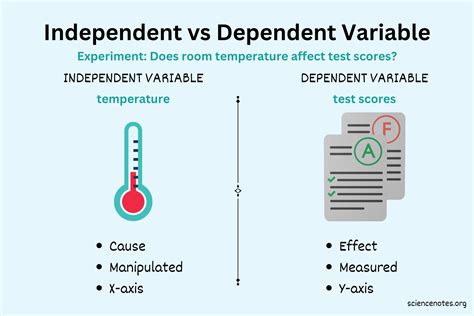
In various fields, including statistics, research, and everyday life, understanding the distinction between independent and dependent variables is crucial. The concept of independent vs dependent variables is fundamental in understanding cause-and-effect relationships, making predictions, and drawing conclusions from data.
To grasp this concept fully, let’s delve into the definitions and roles of these variables in different contexts, including their applications in science, social sciences, and decision-making processes.
Definitions
Independent Variable: This is the variable that is changed or controlled in a scientific experiment or study to test the effects on the dependent variable. It is essentially the cause in a cause-and-effect relationship. The independent variable is manipulated by the researcher to observe its effect.
Dependent Variable: This variable is being tested and measured, and it is expected to change in response to the independent variable. It is the effect in a cause-and-effect relationship. The outcome or result that is measured after changing the independent variable is the dependent variable.
Role in Research
In research, distinguishing between independent and dependent variables is vital for designing experiments, collecting data, and interpreting results. For instance, in a study to determine how different levels of sunlight affect plant growth:
- The independent variable would be the amount of sunlight, as it is the factor being manipulated by the researcher (e.g., plants are placed in different light conditions).
- The dependent variable would be the plant growth, as it is the outcome being measured in response to the change in sunlight.
Understanding the roles of these variables helps researchers to isolate the effect of the independent variable on the dependent variable, thereby establishing a cause-and-effect relationship.
Applications
The concept of independent and dependent variables is not limited to scientific experiments. It is also crucial in social sciences, economics, and decision-making processes. For example:
- In economics, the effect of interest rates (independent variable) on consumer spending (dependent variable) can be studied.
- In education, the impact of teaching methods (independent variable) on student learning outcomes (dependent variable) can be examined.
Interpreting Results
When analyzing the relationship between independent and dependent variables, it’s essential to consider several factors, including:
- Correlation vs Causation: Just because two variables are related, it doesn’t mean that one causes the other. Establishing causation often requires controlled experiments.
- Confounding Variables: Other factors might influence the relationship between the independent and dependent variables, leading to biased results if not accounted for.
- Sample Size and Population: The generalizability of findings depends on the sample size and how well it represents the population.
Conclusion
In conclusion, understanding the distinction between independent and dependent variables is fundamental to conducting meaningful research, interpreting data, and making informed decisions. By recognizing the roles of these variables and considering the complexities of their relationships, individuals can better navigate the intricacies of cause-and-effect dynamics in various contexts.
FAQs
What is the primary difference between independent and dependent variables?
+The primary difference is that the independent variable is the factor being manipulated or changed, while the dependent variable is the outcome being measured in response to the independent variable.
Can a variable be both independent and dependent in different contexts?
+How do you identify independent and dependent variables in a research hypothesis?
+Identifying the variable being manipulated (cause) as the independent variable and the variable being measured (effect) as the dependent variable helps in framing a clear hypothesis.
By mastering the concept of independent and dependent variables, researchers and individuals can develop a deeper understanding of the world around them, fostering more effective experimentation, analysis, and decision-making.