The majestic river delta, a testament to the awe-inspiring power of geological forces. These intricate networks of waterways, sediment, and land have captivated human imagination for centuries, with their unique blend of natural beauty and ecological significance. But have you ever stopped to consider the fascinating process behind their formation? Let’s embark on a journey to unravel the mysteries of river delta creation, exploring the complex interplay of factors that shape these remarkable landscapes.
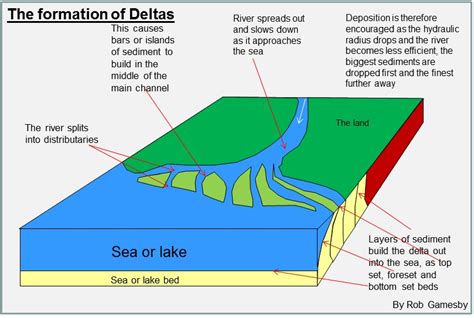
At its core, a river delta is a landform that emerges when a river deposits sediment at its mouth, where it meets a slower-moving body of water, such as an ocean, sea, or lake. This sediment, carried by the river from its upstream sources, can include a wide range of materials, from fine silts and clays to coarser sands and gravels. As the river flows into the standing water, its speed and energy decrease, causing the sediment to be deposited, rather than continued to be transported. Over time, this process creates a network of distributaries, or smaller channels, that branch off from the main river and carry water and sediment into the surrounding environment.
One of the key factors influencing delta formation is the balance between sediment supply and the energy of the receiving water body. When a river carries a high volume of sediment, it tends to create a more extensive delta, with multiple distributaries and a greater accumulation of sediment. Conversely, if the receiving water body has high energy levels, such as strong tidal currents or wave action, it can erode the sediment and limit the delta’s growth. This delicate balance is continually shifting, as changes in sea level, sediment load, and other environmental factors impact the delta’s morphology.
The type of sediment carried by the river also plays a crucial role in shaping the delta’s characteristics. For example, rivers that transport large amounts of fine sediment, such as the Nile or the Amazon, tend to form more extensive and complex deltas, with numerous distributaries and a high degree of sedimentation. In contrast, rivers with coarser sediment loads, like the Rhine or the Mississippi, may produce smaller, more straightforward deltas, with fewer distributaries and less sediment accumulation.
Another critical aspect of delta formation is the concept of autocyclic and allocyclic processes. Autocyclic processes refer to the internal dynamics of the delta system, such as the switching of distributaries, avulsions (sudden changes in the river’s course), and the natural deposition and erosion of sediment. These processes are intrinsic to the delta’s development and can lead to the creation of complex networks of waterways and sedimentary deposits. Allocyclic processes, on the other hand, involve external factors that influence the delta’s formation, such as changes in sea level, tectonic activity, or human impact. These factors can significantly alter the delta’s morphology and evolution, sometimes leading to the creation of entirely new landscapes.
The Ganges-Brahmaputra Delta in India and Bangladesh, for instance, is a prime example of a delta shaped by a combination of autocyclic and allocyclic processes. This vast network of rivers, streams, and wetlands is constantly evolving due to the interplay between the rivers’ sediment load, tidal currents, and human activities such as deforestation and dam construction. The delta’s morphology is characterized by a complex pattern of distributaries, which shift and change over time in response to natural and human-induced factors.
The Ganges-Brahmaputra Delta is not only a remarkable example of delta formation but also a critical component of the regional ecosystem, providing habitat for a diverse range of flora and fauna, and supporting the livelihoods of millions of people.
In addition to their natural beauty and ecological significance, river deltas also play a vital role in the global economy and human well-being. Many of the world’s major cities, such as Amsterdam, Bangkok, and Shanghai, are located on or near deltas, and these regions are often characterized by high population densities, agricultural productivity, and economic activity. Deltas also provide essential ecosystem services, including water filtration, shoreline stabilization, and nurseries for fisheries, which support both local and global food security.
However, deltaic environments are also highly vulnerable to human impact and climate change. Rising sea levels, increased storm frequency and intensity, and changes in precipitation patterns can all lead to erosion, flooding, and saltwater intrusion, threatening the very existence of these delicate ecosystems. Furthermore, human activities such as deforestation, land reclamation, and pollution can exacerbate these problems, putting the long-term sustainability of deltaic environments at risk.
Key Steps for Sustainable Delta Management
- Promote sustainable land use practices, such as reforestation and agroforestry, to reduce sedimentation and protect habitats.
- Implement effective water management strategies, including wetland restoration and flood control measures, to minimize the impact of human activities on deltaic ecosystems.
- Support climate-resilient infrastructure development, such as sea walls, dunes, and green roofs, to protect communities and ecosystems from the effects of climate change.
- Encourage stakeholder engagement and community involvement in delta management, recognizing the critical role that local knowledge and participation play in sustainable decision-making.
As we conclude our journey into the fascinating world of river delta formation, it is essential to recognize the intricate relationships between geological, ecological, and human factors that shape these unique environments. By embracing a deeper understanding of deltaic processes and promoting sustainable management practices, we can work towards preserving the natural beauty, ecological significance, and economic importance of these remarkable landscapes for generations to come.
What is the primary factor influencing river delta formation?
+The primary factor influencing river delta formation is the balance between sediment supply and the energy of the receiving water body.
What are the main differences between autocyclic and allocyclic processes in delta formation?
+Autocyclic processes refer to the internal dynamics of the delta system, such as the switching of distributaries and avulsions, while allocyclic processes involve external factors that influence the delta’s formation, such as changes in sea level, tectonic activity, or human impact.
Why are river deltas important for human well-being and the global economy?
+River deltas are crucial for human well-being and the global economy due to their high population densities, agricultural productivity, and economic activity, as well as their provision of essential ecosystem services, including water filtration, shoreline stabilization, and nurseries for fisheries.