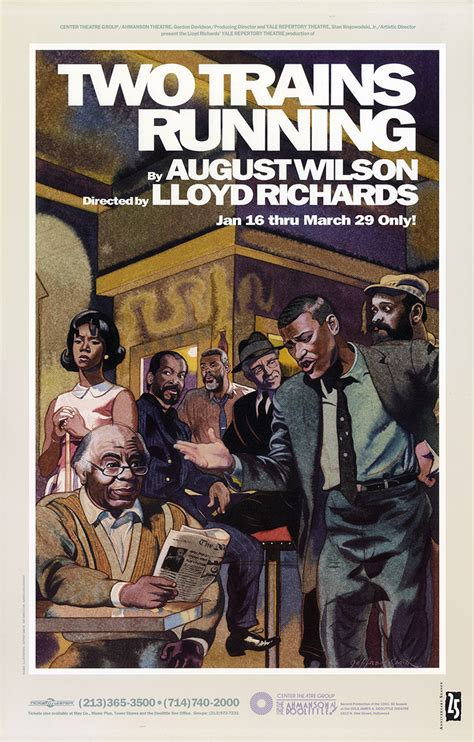
The play “Two Trains Running” by August Wilson is a pivotal work in the American theatre canon, offering a profound exploration of the African American experience during the 1960s. Set in the Hill District of Pittsburgh, Pennsylvania, the play is part of Wilson’s decade-by-decade exploration of the 20th-century Black experience in America, known as the American Century Cycle. “Two Trains Running” specifically focuses on the 1960s, a time of great social change and upheaval, marked by the Civil Rights Movement and the emergence of Black Power.
At its core, “Two Trains Running” is a story about redemption, struggle, and the search for identity and justice. The play takes place in Memphis Lee’s restaurant, a local gathering place that serves as a symbol of community and tradition. Memphis, the protagonist, is trying to sell his restaurant to the city, which is undergoing urban renewal, a process that mirrors the displacement and marginalization of African Americans in urban centers across the United States. Through Memphis’s story and the stories of the people who frequent his restaurant, Wilson delves into themes of identity, community, and the economic and social pressures faced by African Americans during this period.
One of the central themes of “Two Trains Running” is the concept of migration and movement, both physical and metaphorical. The two trains of the title refer to the trains that took African Americans from the rural South to the urban North during the Great Migration, seeking better lives and opportunities. However, the play also explores the idea that these physical movements were often mirrored by spiritual and emotional journeys, as individuals sought to redefine themselves and find their place within the broader American society.
Wilson’s use of language is a hallmark of the play, with characters speaking in rich, poetic dialects that capture the nuances of African American Vernacular English. The dialogue is layered with historical references, mythological allusions, and personal stories, creating a dense tapestry of meaning that reflects the complexity of the African American experience. Through the characters’ conversations, Wilson conveys the sense of community and shared history that exists among them, as well as the tensions and conflicts that arise from their differing perspectives and experiences.
The play also explores the theme of justice, particularly in the context of the Civil Rights Movement. Characters discuss the recent assassination of Malcolm X and the rise of the Black Power movement, reflecting on the need for African Americans to assert their rights and challenge the systemic racism that has oppressed them for centuries. The character of Sterling, a young man recently released from prison and seeking to make a new life for himself, embodies this quest for justice and self-determination, as he navigates the challenges of racism and economic exploitation.
In addition to its exploration of historical and social themes, “Two Trains Running” is also notable for its use of dramatic structure and character development. Wilson employs a non-linear narrative, with scenes and characters overlapping in complex ways to create a sense of depth and layered meaning. The play’s use of symbolism, particularly in the figure of the restaurant and the character of Aunt Ester, adds another dimension to the narrative, inviting audiences to consider the spiritual and philosophical dimensions of the characters’ experiences.
Aunt Ester, a 322-year-old wise woman who is said to have the power to heal and advise, is a particularly significant figure in the play. She represents a connection to African traditions and the ancestral past, offering guidance and wisdom to the characters as they navigate their challenges. Through Aunt Ester, Wilson highlights the importance of African American cultural heritage and the need to preserve and honor the past, even as individuals and communities move forward into an uncertain future.
The play’s conclusion, with its sense of hope and possibility, underscores Wilson’s message about the resilience and strength of African American communities. Despite the many challenges and injustices they face, the characters in “Two Trains Running” find ways to persevere, to support one another, and to envision a better future. This message of hope and redemption is central to the play’s impact, encouraging audiences to reflect on the ongoing struggle for justice and equality in American society.
August Wilson's "Two Trains Running" is a masterpiece of American theatre, offering a nuanced and powerful exploration of the African American experience during the 1960s. Through its rich characters, layered dialogue, and exploration of themes such as identity, community, and justice, the play provides a profound commentary on the human condition.
In terms of its production history, “Two Trains Running” premiered in 1990 at the Yale Repertory Theatre and later opened on Broadway at the Walter Kerr Theatre in 1992. The play was nominated for several awards, including the Tony Award for Best Play and the Pulitzer Prize for Drama. Its success helped to cement August Wilson’s reputation as one of the leading playwrights of his generation, and it remains one of his most celebrated and frequently performed works.
For readers interested in exploring the play further, there are several key themes and motifs to consider. One of the most significant is the idea of memory and how it shapes our understanding of ourselves and our communities. The characters in “Two Trains Running” are deeply rooted in their pasts, and their memories of historical events, personal experiences, and cultural traditions inform their present realities. This emphasis on memory highlights the importance of preserving and honoring African American history and culture, even as individuals and communities move forward into the future.
Another key theme is the concept of sacrifice and how it relates to the pursuit of justice and equality. Several characters in the play make significant sacrifices, whether it be their freedom, their relationships, or their very lives, in order to challenge the status quo and fight for a better world. This theme serves as a powerful reminder of the ongoing struggle for human rights and dignity, and the need for individuals to take action and make sacrifices in order to create positive change.
What is the historical context of "Two Trains Running"?
+"Two Trains Running" is set in the 1960s, a time of great social change and upheaval in the United States. The play explores the African American experience during this period, including the Civil Rights Movement and the emergence of Black Power.
What is the significance of the character of Aunt Ester?
+Aunt Ester is a 322-year-old wise woman who represents a connection to African traditions and the ancestral past. She offers guidance and wisdom to the characters, highlighting the importance of preserving and honoring African American cultural heritage.
What themes are explored in "Two Trains Running"?
+The play explores themes such as identity, community, justice, and redemption, offering a nuanced and powerful commentary on the African American experience during the 1960s.
In conclusion, “Two Trains Running” is a landmark play that offers a profound exploration of the African American experience during the 1960s. Through its rich characters, layered dialogue, and exploration of themes such as identity, community, and justice, the play provides a powerful commentary on the human condition. As a work of American theatre, it continues to resonate with audiences today, inviting us to reflect on the ongoing struggle for justice and equality in our society.