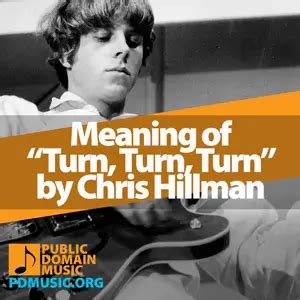
The iconic song “Turn! Turn! Turn!” by The Byrds, released in 1965, is a timeless classic that has been a staple of folk rock music for decades. But have you ever wondered what inspired this hauntingly beautiful song? The answer lies in the Bible, specifically in the Book of Ecclesiastes, Chapter 3, verses 1-8.
The song’s writer, Pete Seeger, was inspired by these biblical verses, which speak to the cyclical nature of life and the inevitability of change. The passage reads: “To every thing there is a season, and a time to every purpose under the heaven: A time to be born, and a time to die; a time to plant, and a time to pluck up that which is planted; A time to kill, and a time to heal; a time to break down, and a time to build up; A time to weep, and a time to laugh; a time to mourn, and a time to dance; A time to cast away stones, and a time to gather stones together; a time to embrace, and a time to refrain from embracing; A time to get, and a time to lose; a time to keep, and a time to cast away; A time to rend, and a time to sew; a time to keep silence, and a time to speak; A time to love, and a time to hate; a time of war, and a time of peace.”
Seeger was struck by the wisdom and poetry of these verses, which seemed to capture the essence of the human experience. He set the words to music, using a melody that was reminiscent of a traditional folk tune. The result was “Turn! Turn! Turn!”, a song that would become an anthem for a generation of young people seeking change and social justice.
The Byrds’ version of “Turn! Turn! Turn!” was a major hit, reaching the top of the Billboard charts in 1965. The song’s success can be attributed to its catchy melody, memorable lyrics, and the band’s distinctive folk rock sound. But beyond its commercial success, “Turn! Turn! Turn!” has become a cultural touchstone, symbolizing the ideals of peace, love, and social change that defined the 1960s.
A Closer Look at the Lyrics
The song’s lyrics are a masterful adaptation of the biblical text, with Seeger’s addition of a few original lines to create a sense of cohesion and flow. The verses are structured around the theme of duality, with each line presenting a contrasting idea or image. For example, “a time to be born, and a time to die” or “a time to weep, and a time to laugh”. This use of contrasting ideas creates a sense of tension and release, underscoring the cyclical nature of life.
Impact and Legacy
“Turn! Turn! Turn!” has had a profound impact on popular music and culture. The song’s message of peace, love, and social change resonated with a generation of young people, inspiring countless covers, adaptations, and references in other songs, films, and literature. The song’s influence can be heard in the work of artists such as Bob Dylan, Joni Mitchell, and Neil Young, among many others.
In conclusion, “Turn! Turn! Turn!” is a song that continues to inspire and captivate audiences to this day. Its timeless message, memorable melody, and poignant lyrics have made it a classic of American music, a testament to the power of art to transcend time and culture.
What inspired Pete Seeger to write “Turn! Turn! Turn!”?
+Pete Seeger was inspired by the biblical passage from Ecclesiastes, Chapter 3, verses 1-8, which speaks to the cyclical nature of life and the inevitability of change.
What is the significance of the song’s use of biblical imagery?
+The song’s use of biblical imagery and themes was a deliberate choice by Seeger, who wanted to tap into the deeper cultural and spiritual heritage of America, making the song’s message more relatable and accessible to a wider audience.
What is the impact of “Turn! Turn! Turn!” on popular music and culture?
+“Turn! Turn! Turn!” has had a profound impact on popular music and culture, inspiring countless covers, adaptations, and references in other songs, films, and literature, and continues to be a timeless classic of American music.