The debate between “sneak” and “snuck” has been a longstanding one in the English language, with different regions and grammatical traditions often favoring one form over the other. At its core, the issue revolves around the past tense of the verb “to sneak,” which means to move stealthily or secretly. Understanding the nuances between “sneak” and “snuck” requires a delve into the historical development of the verb and the grammatical rules governing its use.
Historical Context
The verb “sneak” originates from Old English and has evolved over time. Initially, “sneak” was used in its base form for the present tense and formed its past tense and past participle regularly with the addition of “-ed” for the past tense, resulting in “sneaked.” This pattern follows the typical conjugation of regular verbs in English.
Sneaked vs. Snuck
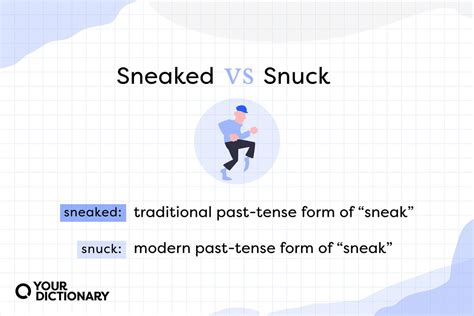
Sneaked: This is the more traditionally accepted past tense of “sneak,” formed by adding “-ed” to the base form of the verb, consistent with the conjugation pattern of regular English verbs. “Sneaked” has been used for centuries and is widely recognized as grammatically correct in both British and American English.
Snuck: The past tense “snuck” is a more recent development, especially prominent in American English. It emerged as an irregular form, analogous to verbs like “stick” (stuck) or “strike” (struck), where the past tense does not follow the regular “-ed” addition. “Snuck” gained popularity in the 19th century and has since become commonly used and accepted in informal contexts, particularly in the United States.
Grammatical Acceptance and Usage
Both “sneaked” and “snuck” are now recognized by dictionaries and style guides, although their acceptance can vary depending on the context, geographical location, and personal preference.
Formal Writing and British English: In formal writing and particularly in British English, “sneaked” is often preferred due to its adherence to traditional verb conjugation rules and its historical precedence.
Informal Writing and American English: “Snuck” has become increasingly acceptable, especially in informal contexts and in American English. Its use is widespread in everyday conversation, media, and even in some formal writings in the United States.
Conclusion
The choice between “sneaked” and “snuck” ultimately depends on the writer’s or speaker’s preference, the regional dialect, and the formality of the context. While “sneaked” retains a more traditional and universally accepted status, “snuck” has carved out its place in modern English, especially in informal and American contexts. Understanding these nuances can help individuals tailor their language use appropriately, ensuring clarity and grammatical appropriateness in their communication.
Practical Application Guide
For those looking to practically apply the understanding of “sneak,” “sneaked,” and “snuck,” here are a few key takeaways: - In Formal or International Contexts: Opt for “sneaked” for consistency and broader acceptance. - In Informal American English: “Snuck” is commonly used and understood. - For Clarity and Precision: Consider the audience and the formality of the communication to decide between “sneaked” and “snuck.”
By recognizing the historical, grammatical, and regional factors influencing the use of “sneaked” and “snuck,” individuals can enhance their command of English and navigate linguistic variations with confidence.
Is "snuck" grammatically correct?
+Yes, "snuck" is recognized as a valid past tense form of "sneak," particularly in American English and informal contexts.
Which is more traditionally accepted, "sneaked" or "snuck"?
+"Sneaked" is the more traditionally accepted form and is preferred in formal writing and British English due to its regular formation.
Can both "sneaked" and "snuck" be used in the same text?
+While it's technically possible, consistency within a piece of writing is usually preferred for clarity and style. Choose one form based on the context and audience.
As language evolves, so too does our understanding and application of its intricacies. The debate between “sneaked” and “snuck” highlights the dynamic nature of English, accommodating both traditional grammar and modern usage preferences. By embracing these variations, we can communicate more effectively, respecting both the historical roots of our language and its contemporary expressions.