
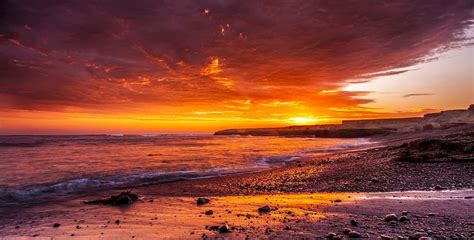
As the day winds down, the sky transforms into a kaleidoscope of warm hues, signaling the approach of sunset. This fleeting moment, often referred to as the golden hour, is a coveted time for photographers, outdoor enthusiasts, and anyone seeking to bask in the beauty of nature. But have you ever wondered what determines the timing of sunset, and how you can make the most of this enchanting hour?
To unravel the mystery of sunset timing, let’s delve into the celestial mechanics that govern our planet’s rotation and orbit. The Earth’s rotation on its axis, combined with its elliptical orbit around the Sun, results in varying sunset times throughout the year. The tilt of our planet’s axis, approximately 23.5 degrees, also plays a significant role in determining the timing and duration of sunset.
As the Earth rotates from west to east, different regions experience sunset at different times. The timing of sunset is also influenced by the time of year, with longer days during summer months and shorter days during winter. This variation is due to the Earth’s elliptical orbit, which causes the planet to move at different speeds throughout the year. When the Earth is closer to the Sun (perihelion), the days are shorter, and when it’s farther away (aphelion), the days are longer.
Now, let’s explore how to calculate the timing of sunset for any given location. One method is to use astronomical tables or online calculators, which provide the exact time of sunset based on the location’s latitude, longitude, and time zone. These tools take into account the Earth’s rotation, orbit, and axial tilt to generate accurate timing. Alternatively, you can use mobile apps or software that leverage GPS and astronomical data to predict sunset times.
For instance, if you’re planning a photography shoot in New York City, you can use an online calculator to determine the sunset time for a specific date. Let’s say you want to capture the golden hour on June 21st, the summer solstice. According to astronomical tables, the sunset time for New York City on this day would be around 8:30 PM EDT. With this information, you can plan your shoot accordingly, ensuring you’re in position to capture the warm, golden light.
To make the most of the golden hour, it's essential to understand the concept of twilight. Twilight is the period of time when the Sun is below the horizon, but the sky is still illuminated by the Sun's rays. There are three types of twilight: civil, nautical, and astronomical. Civil twilight, which occurs when the Sun is between 0 and 6 degrees below the horizon, is the most relevant for photographers and outdoor enthusiasts.
In addition to calculating sunset times, it’s crucial to consider the impact of atmospheric conditions on the quality of light during the golden hour. Cloud cover, pollution, and dust particles in the air can scatter shorter wavelengths of light, such as blue and violet, leaving mainly longer wavelengths like red and orange to reach our eyes. This phenomenon is known as Rayleigh scattering, and it’s responsible for the warm, golden hues we associate with sunset.
To illustrate the effect of atmospheric conditions, let’s consider a scenario where a high-pressure system is dominating the weather pattern in a region. In this case, the air is typically clearer, with fewer particles to scatter the light. As a result, the sunset will likely be more vibrant, with deeper hues of red and orange. On the other hand, if a low-pressure system is present, the air may be more turbulent, with increased cloud cover and particles. This can lead to a more subdued sunset, with softer, pastel colors.
| Atmospheric Condition | Effect on Sunset |
|---|---|
| Clear skies | Vibrant, deep hues of red and orange |
| Cloud cover | Softer, pastel colors |
| Pollution | Increased scattering of shorter wavelengths, leading to a more orange-brown hue |

As we’ve explored the intricacies of sunset timing and the golden hour, it’s clear that this phenomenon is a complex interplay of celestial mechanics, atmospheric conditions, and human perception. By understanding these factors, we can better appreciate the beauty and uniqueness of each sunset, and make the most of this fleeting moment.
In conclusion, the timing of sunset is a fascinating topic that combines astronomy, physics, and human experience. Whether you’re a photographer, outdoor enthusiast, or simply someone who appreciates the beauty of nature, understanding the intricacies of sunset timing can help you make the most of this enchanting hour.
What is the difference between sunrise and sunset times?
+Sunrise and sunset times differ due to the Earth's rotation and orbit. Sunrise occurs when the Sun rises above the horizon, while sunset occurs when it sets below the horizon. The timing of these events varies throughout the year due to the Earth's elliptical orbit and axial tilt.
How do time zones affect sunset times?
+Can I use mobile apps to predict sunset times?
+Yes, there are numerous mobile apps available that can predict sunset times based on your location. These apps often leverage GPS and astronomical data to provide accurate timing.
By embracing the complexities of sunset timing and the golden hour, we can deepen our appreciation for the natural world and the beauty that surrounds us. Whether you’re a seasoned photographer or simply someone who enjoys watching the sunset, this fleeting moment is a reminder of the awe-inspiring beauty that awaits us every day.
